At its zenith, the Roman Empire was a marvel of engineering, culture, and governance, stretching across three continents and encompassing diverse peoples and landscapes. This vast territory not only showcased the might of Rome but also facilitated the exchange of ideas, goods, and innovations that shaped the ancient world. Understanding the empire’s expanse through a detailed map reveals the strategic importance of key cities and trade routes that fueled its growth.
Exploring the Roman Empire map at peak offers a fascinating glimpse into its intricate network of provinces and territories. From the bustling streets of Rome to the far reaches of Britannia and Egypt, each region contributed to the empire’s legacy. By analyzing this map, one can appreciate how geography influenced military campaigns, economic prosperity, and cultural interactions, ultimately leaving an indelible mark on history.
Overview of the Roman Empire
The Roman Empire reached its peak in 117 AD, encompassing approximately 5 million square kilometers across Europe, North Africa, and parts of Asia. The empire hosted a population of around 70 million, representing nearly 25% of the world’s population at that time. Cities such as Rome, Alexandria, and Carthage thrived as cultural and economic hubs.
Its governance featured a complex system, including the Senate, popular assemblies, and various magistrates overseeing different regions. The legal framework established, known as Roman law, profoundly influenced modern legal systems. The military maintained order and security, with legions stationed strategically along borders and vital trade routes.
Infrastructure innovations, such as roads, aqueducts, and public buildings, facilitated communication and commerce. For instance, the Roman road network stretched over 400,000 kilometers, enhancing trade and troop movement. The Pax Romana, a period of relative peace and stability (27 BC – 180 AD), allowed for cultural exchanges and economic prosperity, solidifying its dominance.
The empire’s cultural achievements included advancements in art, architecture, literature, and philosophy. These contributions continued to shape Western civilization long after the empire’s decline. Key figures like Cicero and Virgil exemplified the literary brilliance of this era.
Geographic Extent of the Empire
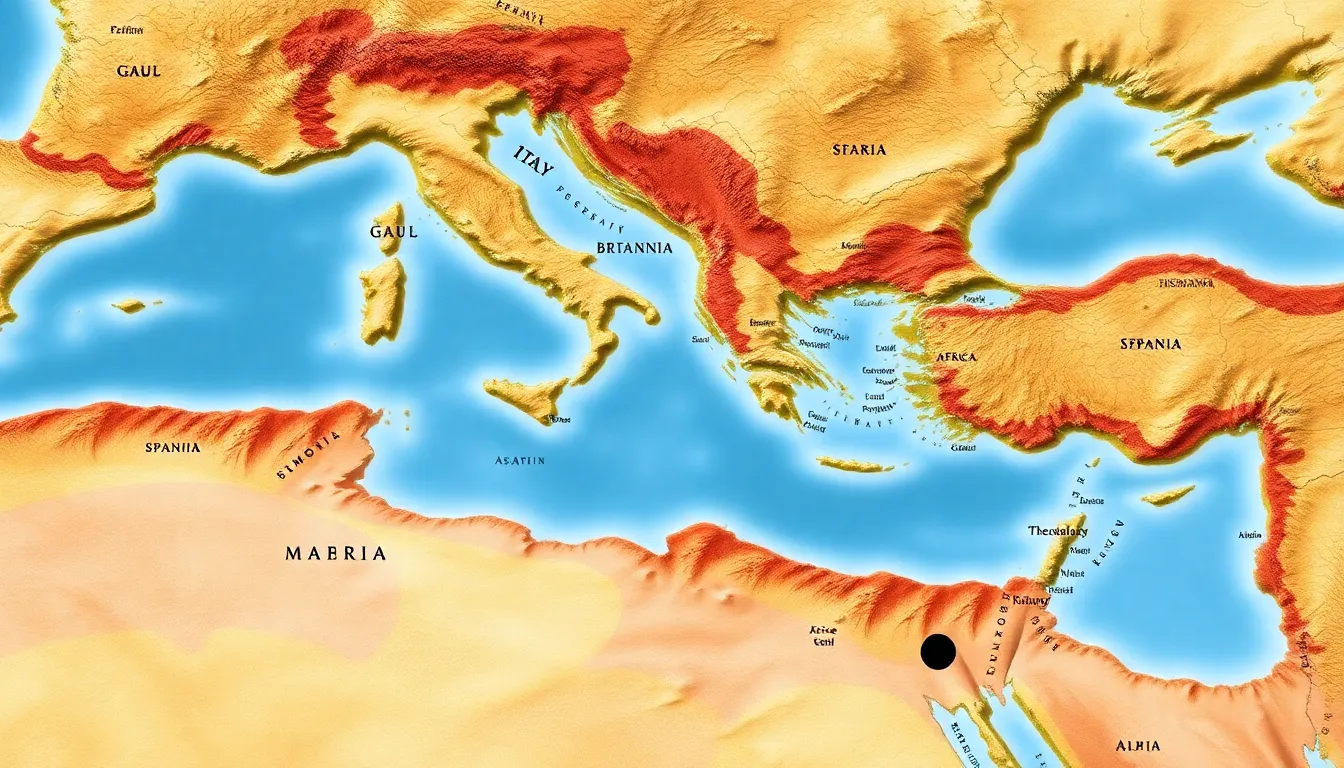
The Roman Empire’s geographic span at its peak in 117 AD defined its power and influence. Encompassing diverse landscapes, the empire reached across Europe, North Africa, and parts of Asia, shaping cultures and economies.
Key Territories Included
- Italy: Core of the empire, it housed Rome, the political heart and cultural center.
- Gaul: Modern-day France, known for its agricultural resources and strategic location.
- Britannia: Included territory in present-day England, facilitating control over trade routes.
- Hispania: Covered modern Spain and Portugal, rich in minerals and agricultural outputs.
- Africa Proconsularis: Northern Africa, important for grain production and trade.
- Asia Minor: Present-day Turkey, a crucial crossroads for trade between Europe and Asia.
- Eastern Mediterranean: Regions including Greece and Judea, known for their cultural significance and economic activity.
Natural Borders and Features
Natural borders shaped the extent of the Roman Empire, providing both obstacles and advantages.
- The Rhine River: Served as a frontier against Germanic tribes in northern Europe.
- The Danube River: Functioned as a barrier and a trade route, connecting various provinces.
- The Sahara Desert: Acted as a natural barrier, limiting expansion into sub-Saharan Africa.
- The Mediterranean Sea: Facilitated trade and military movement, while serving as a natural boundary.
- The Alps: Provided a formidable barrier against invasions from the north, protecting the Italian peninsula.
Historical Context of the Peak
The Roman Empire reached its zenith in the 2nd century AD, characterized by remarkable territorial expansion and cultural flourishing. Understanding the timeline and significant events of this period highlights the factors that contributed to its growth and dominance.
Timeline of Growth
- 753 BC: Founding of Rome marks the beginning of what would become a formidable power.
- 509 BC: Establishment of the Roman Republic initiates territorial expansion through military conquests.
- 264-146 BC: The Punic Wars against Carthage lead to dominance over the western Mediterranean, securing provinces like Hispania and North Africa.
- 58-50 BC: Julius Caesar’s campaigns in Gaul result in its incorporation into the Republic, significantly increasing resources and territory.
- 27 BC: Octavian becomes Augustus, transitioning Rome into an empire and marking the start of the Pax Romana.
- 14-117 AD: The empire expands to its greatest territorial extent under emperors Trajan and Hadrian, encompassing vast regions across Europe, North Africa, and parts of Asia.
- 117 AD: At its peak, the empire covers approximately 5 million square kilometers and serves about 70 million inhabitants.
Significant Events Leading to Expansion
- Roman Conquests: Military campaigns, such as those led by Scipio Africanus and Julius Caesar, expanded territory and influence.
- Political Alliances: Strategic alliances with local rulers allowed for smoother incorporations of new territories.
- Economic Prosperity: Control over trade routes bolstered economic growth, enabling resource mobilization for military campaigns.
- Infrastructure Development: Construction of roads and ports facilitated troop movement, trade, and governance, reinforcing regional control and cohesion.
- Cultural Integration: Adoption and adaptation of local customs and practices eased the assimilation of conquered territories into the empire’s framework.
Each of these events and developments played a vital role in shaping the Roman Empire at its peak, reinforcing its position as a dominant force in the ancient world.
Cultural and Economic Impact
The cultural and economic impact of the Roman Empire at its peak is evident in trade, regional influence, and the integration of diverse cultures. Following are detailed insights into these significant areas.
Trade Routes and Economy
Trade routes, crucial to the empire’s economy, connected regions across Europe, North Africa, and Asia. The extensive road network of over 400,000 kilometers facilitated the movement of goods, people, and ideas. Key routes included the Via Appia, linking Rome to the South, and roads leading to the Eastern Mediterranean ports. Economic activity thrived with the exchange of commodities such as grain from Egypt, wine from Hispania, and olive oil from Italy.
Merchants played pivotal roles in urban economies, with cities like Rome and Carthage serving as bustling trade centers. The standardization of currency, with the introduction of the denarius, simplified transactions, promoting commerce. Evidence shows that a vibrant marketplace culture emerged, where artisans and traders contributed to local economies, further enriching the empire’s wealth.
Influence on Neighboring Regions
The Roman Empire’s influence extended to neighboring regions, transforming cultural and political landscapes. Trade brought not only wealth but also cultural exchanges, fostering the spread of Roman law, governance structures, and lifestyle practices across conquered territories. The incorporation of local customs into Roman traditions created a unique blend of cultures.
Roman architecture, infrastructure, and urban planning impacted cities within the empire and beyond. Major cities, such as Alexandria and Carthage, adopted Roman designs, featuring theaters and public baths. The Pax Romana facilitated stability, allowing neighboring tribes and nations to engage peacefully with Roman influences, creating a legacy that shaped history well beyond the empire’s dissolution.
Notable Cities on the Map
Key cities shaped the Roman Empire’s cultural and economic landscape, serving as vital hubs for governance, trade, and social interaction.
Capital: Rome
Rome, the capital, represented the heart of the empire. Positioned on the Tiber River, it provided strategic access to trade routes. The city’s population exceeded 1 million at its peak, featuring iconic structures like the Colosseum and the Forum. Rome functioned as a political center, housing the Senate and imperial administration. Its influence extended globally, establishing laws and cultural practices that continue to resonate today.
Other Major Urban Centers
- Alexandria: Located in Egypt, Alexandria thrived as a center of learning and commerce. It housed the Great Library and served as a key port for grain shipments to Rome, connecting Africa with the Mediterranean.
- Carthage: Situated in modern-day Tunisia, Carthage emerged as a significant trade city. Its strategic port facilitated control over western Mediterranean trade routes and played a crucial role during and after the Punic Wars.
- Antioch: Positioned in present-day Turkey, Antioch became an essential urban center known for its diverse population and rich cultural exchange. The city served as a critical hub for trade between Asia and the Mediterranean.
- Ephesus: Located in modern Turkey, Ephesus featured a major harbor and was pivotal for trade routes. Its famous Temple of Artemis symbolized the city’s wealth and cultural significance.
- Corinth: This city controlled trade between mainland Greece and the Peloponnese. Corinth’s strategic position allowed it to flourish economically and culturally, leading to its status as a major urban center.
- Syracuse: Situated on the island of Sicily, Syracuse acted as a vital naval base and trade power. It played a significant role in both the Sicilian and Punic Wars, contributing to the empire’s military strength.
- Lugdunum (Lyon): Located in Gaul, Lugdunum served as a major administrative center. Its location made it a crossroads for trade routes connecting the north and south of the empire.
These cities illustrated the vast network of urban centers integral to the Roman Empire’s administration, economy, and cultural development.
The Roman Empire at its peak remains a fascinating subject that continues to captivate historians and enthusiasts alike. Its remarkable achievements in governance, culture, and engineering set a foundation that influenced civilizations for centuries. The intricate network of trade routes and cities not only facilitated economic prosperity but also fostered cultural exchanges that shaped the world.
Understanding the empire’s geographic extent and strategic significance provides valuable insights into how it maintained control over its vast territories. The legacy of Roman law, architecture, and urban planning continues to resonate in modern society, proving that the impact of the empire extends far beyond its decline. The story of the Roman Empire is a testament to human ingenuity and resilience, leaving an indelible mark on history.